
Review · TUNISIA
Zaghouan, Thuburbo Majus and Dougga Private Self-Guided Excursion from Hammamet
The best part of this day trip is its sweep through Roman Tunisia. In one long outing, you trace the water system from Zaghouan’s Water Temple to its aqueduct, then walk through two major ancient cities, Thuburbo Majus and Dougga. I like the private vehicle and the freedom to set your own pace. You get up to three people in the car, not a large group moving by whistle.
I also like the strong contrast between the stops: Zaghouan explains how Roman engineers moved water, while Dougga gives you grand temples, a forum, a theater area, and broad views across a 65-hectare site. The main drawback is clear: this is not a guided tour. Your driver takes you there, but a local guide and detailed explanations at the ruins are not included.
Key points to know before booking
- Zaghouan connects the whole day: The Water Temple and aqueduct show where the Roman water supply began and how it reached cities such as Carthage and Thuburbo Majus.
- Thuburbo Majus needs time: Plan about three hours to see its Capitol, forum, baths, villas, temples, church, and market square.
- Dougga is the main event: You get roughly three hours at Tunisia’s best-preserved Roman city and a UNESCO World Heritage site.
- Private means flexible: Only your group participates, and you can spend more or less time at each stop within the long day.
- Budget for site fees and lunch: The stated entrance charge is 3 euros per person, and lunch is not included.
- The price works best for a small group: At $279.58 for up to three people, the cost is easier to justify when shared.
Why this route is more than a ruins checklist
Many ancient-site day trips give you one famous stop and a lot of road time. This route has a useful thread running through it: water, cities, and Roman power. Zaghouan is not simply a scenic first stop. It explains the practical problem that made large Roman settlements possible.
The Water Temple marks the source of an important aqueduct. From here, water was carried toward several Roman cities, including Carthage and Thuburbo Majus. That makes the later aqueduct stop easier to understand. You are not looking at unrelated stones. You are following part of an old supply system.
I like that the day then moves from engineering to city life. At Thuburbo Majus, you can picture public buildings, baths, religious sites, and private villas. At Dougga, the scale and preservation give the day its strongest finish.
The tradeoff is the length. With eight to ten hours on the road and at the sites, this is a full day rather than a light outing from Hammamet. You should be comfortable walking over archaeological ground and spending time outdoors. The required fitness level is described as moderate, so this is not the right pick if you need a very easy sightseeing day.
Self-guided soaks around Hammamet:
- Kairouan, El Djem, Monastir Self-Guided Excursion from Hammamet
★ 4.5 · 5 reviews - Tunis, Carthage and Sidi Bou Said Self-Guided Excursion from Hammamet
★ 4.5 · 4 reviews - Cap-Bon Self-Guided Excursion from Hammamet
★ 4.5 · 3 reviews
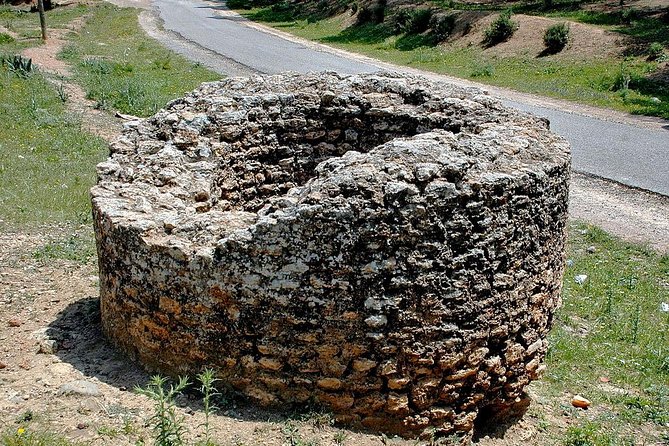
The Water Temple at Zaghouan
The first stop takes about an hour and has no admission fee listed. The Water Temple is important because it marks the source linked to the Roman aqueduct system. It gives you a practical starting point for the day: before you see Roman streets and temples, you see the water supply that helped support them.
I would use this stop to get your bearings and read any available signs carefully. Since no local guide is included, you should not expect a full explanation of the site from the driver. The value here comes from connecting the place to the rest of the route.
One hour is a sensible amount of time. It lets you look around without turning the first stop into a long delay. The site is also a useful reminder that Roman infrastructure was often as important as the monuments built around it.
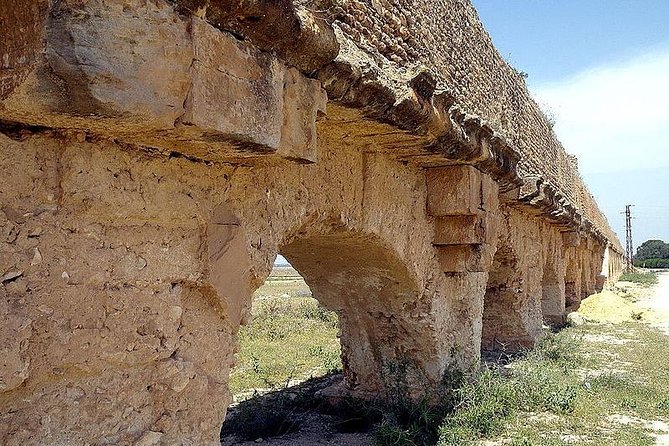
The Roman aqueduct stop near Zaghouan
The next stop lasts about 30 minutes. It is a short visit to an ancient Roman aqueduct that distributed water from the Water Temple toward places including Thuburbo Majus and Carthage.
This is not the longest stop, but it gives the route a clear visual link. At the temple, you saw the source. Here, you see part of the system that carried the water onward. The connection adds more meaning to the later visit at Thuburbo Majus.
Keep your expectations in check. The information provided describes this as a small stop, not a large archaeological complex with a long visit. I would treat it as a useful photo and context break between the main sites rather than a destination that needs hours.
Three hours among the ruins of Thuburbo Majus
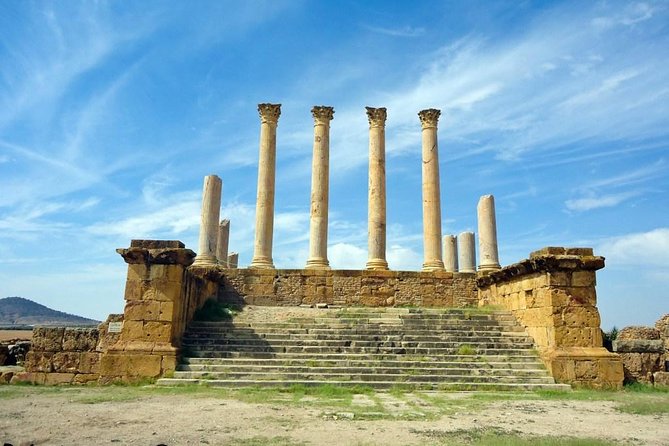
Thuburbo Majus is where the day starts to feel like a walk through a real Roman town rather than a single monument. You are given about three hours here, which matters because the site includes several distinct areas.
The Capitol and forum are central to understanding public life. The villa of Neptune offers a look at a more private setting, while the Palestra of the Petronii points to exercise and social activity. You can also see the Temple of Mercury, a Byzantine church, the summer baths, the winter baths, and the market square.
That list tells you how varied the site is. It is not only about temples. You can think about religion, commerce, bathing, civic government, leisure, and later use of the city. The two bath complexes are especially useful for seeing how Roman public life was shaped around shared facilities.
Three hours gives you room to move at a reasonable pace, but it does not mean you should inspect every stone equally. Without a guide, I would choose a few anchor points before you enter: the Capitol, forum, villa, baths, and market square. Then use the remaining time for the smaller temples and church.
Admission is not included. The stated archaeological-site fee is 3 euros per person. Because the supplied information does not break down that charge by site, check how it is applied when booking or at the entrance. Personal expenses also remain yours.
Guided soaking days around Hammamet:
- Kairouan & El Djem Guided Day Trip with Lunch from Hammamet
★ 4.0 · 18 reviews - Private Guided Excursion Tunis, Carthage and Sidi Bou Said from Hammamet
★ 5.0 · 8 reviews - Kairouan, El Djem and Monastir Guided Excursion from Hammamet
★ 5.0 · 5 reviews - Guided Excursion Cap-Bon from Hammamet
★ 5.0 · 2 reviews
Dougga, the strongest stop of the day
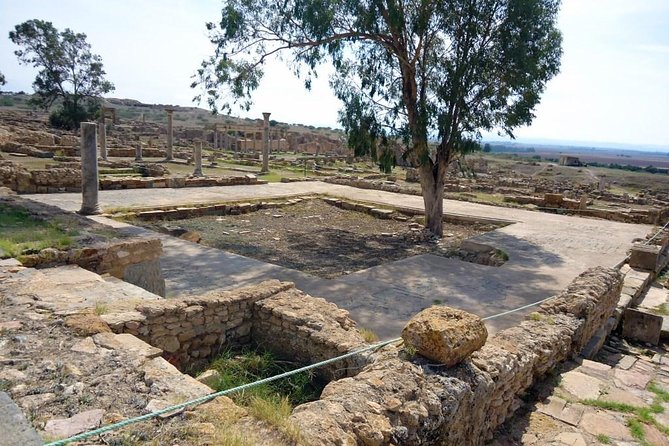
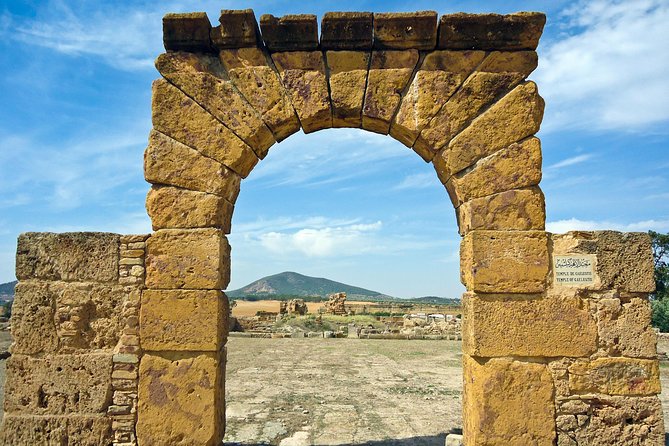
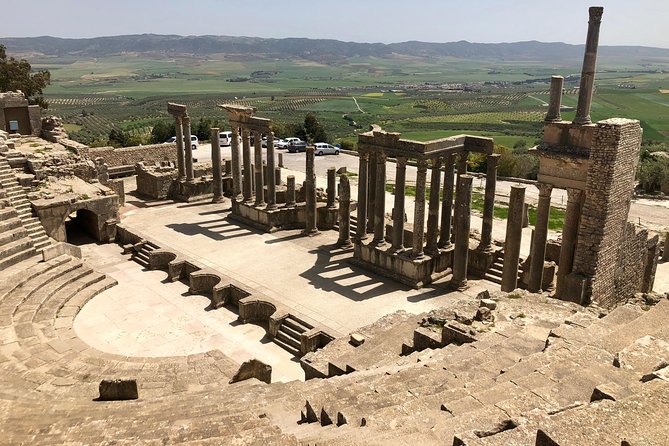
Dougga receives about three hours, and this is the site that will likely decide if the trip is right for you. It is listed as a UNESCO World Heritage site and covers 65 hectares. The scale alone means you should arrive with comfortable shoes, water, and a plan to pace yourself.
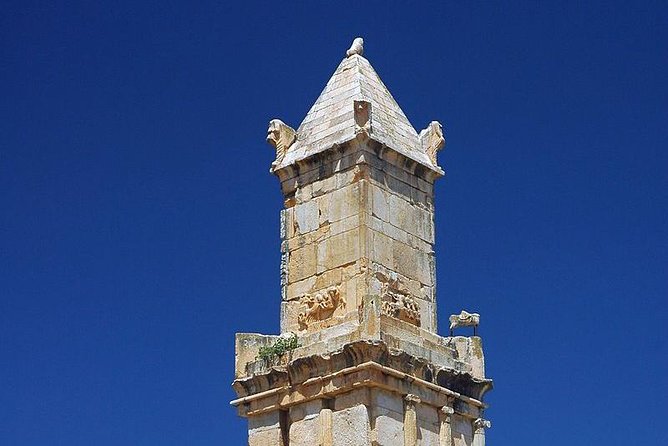
The site is described as the most preserved Roman city in North Africa. The monuments include the Capitol, the Wind Rose, the Libyco-Punic Mausoleum, dolmens, the market, the Villa of the Trifolium, the Temple of Mercury, the Temple of Minerva, and the Temple of Saturn.
That mix makes Dougga especially rewarding. You are not seeing only one Roman period. The Libyco-Punic Mausoleum and dolmens point to older traditions, while the Roman temples, market, villas, and Capitol show how the city developed under Roman influence. The result is a place where the layers of North African history are visible across a very large area.
The three-hour visit is generous but not excessive. Dougga is large enough that you may need to choose between a broad walk and a slower look at individual monuments. Your driver will not function as a site guide, so bring your own guidebook or research notes if you want names, dates, and explanations to stick.
I would save energy for the final stop. Thuburbo Majus is substantial, but Dougga is the point where the day’s scale comes together. You can connect the city’s public spaces, religious buildings, homes, and older monuments with the water story that began at Zaghouan.
A private car, not a private guided tour
The tour uses an air-conditioned vehicle and private transportation. Pickup is offered in Hammamet, and only your group participates. For a route with several sites spread across a long day, that setup is valuable. You avoid coordinating with strangers and can discuss timing with the driver.
The private format also gives you some control. If you need more time at Dougga and less at a minor stop, you have a better chance of adjusting the day than you would on a fixed group coach. The stated duration is approximately eight to ten hours, so the exact rhythm matters.
Still, keep the roles clear. Your driver handles transportation, parking fees, and the route. A local guide in English, French, Italian, German, Spanish, or Russian is specifically not included. You should not book this expecting a continuous spoken tour at every monument.
One French-language comment praised a guide as competent and friendly, but the current tour details describe a self-guided outing with a driver. I would confirm the arrangement if having a licensed site guide is important to you. That small check can prevent a mismatch in expectations.
The vehicle includes one bottle of water per passenger. That is helpful, but on a long day with several outdoor sites, you may want to buy or carry more. The supplied details do not state that meals or extra drinks are provided.
What the $279.58 price really means
The price is $279.58 per group of up to three people. Shared three ways, that is about $93 per person before site fees and lunch. Shared by two, it is about $140 per person, while a solo booking pays the full group price.
That makes the tour most attractive for a couple, family, or small group that values a private car. The price includes air conditioning, private transport, parking, bottled water, and gratuities. Those inclusions reduce the need to handle several small costs during a long day.
You still need to pay for archaeological-site admission, listed as 3 euros per person, plus lunch and personal expenses. Lunch is not arranged, but the driver can recommend places to eat. That flexibility may suit you if you prefer to choose your own meal, though it means you should plan for a stop rather than assume one is built into the price.
The value is less convincing for a solo visitor who mainly wants expert interpretation. In that case, part of what you are paying for is the private vehicle and convenience, not a guided education at the ruins. For three people sharing the car, the balance is much better.
Who will get the most from this day
I would recommend this trip to you if you want to see several important sites in one outing and prefer a private schedule. It suits people who enjoy reading signs, using a guidebook, or preparing a little before visiting ancient ruins.
It also works well if you want to connect Roman engineering with Roman urban life. The Water Temple and aqueduct give the day a clear theme, while Thuburbo Majus and Dougga provide enough monuments to keep the history from feeling abstract.
You may want a different arrangement if you need a guide at every site. The absence of a local guide is not a small detail here. Dougga and Thuburbo Majus are extensive, and names such as the Capitol, Villa of the Trifolium, Palestra of the Petronii, and Libyco-Punic Mausoleum mean much more when someone explains what you are seeing.
You should also think carefully about stamina. The day lasts eight to ten hours, with about six hours assigned to the archaeological stops alone. A moderate level of physical fitness is expected, and the route is not designed as a short, low-effort sightseeing trip.
Practical details that affect your decision
Pickup is offered from Hammamet, and confirmation is provided at booking. The activity is private, so your group is the only group participating. Service animals are allowed.
Free cancellation is available if you cancel at least 24 hours before the start time. Cancellations or changes made less than 24 hours before the start time are not accepted for a refund, and the cut-off follows local time.
The experience provider is taximami. Since the outing is self-guided, I would prepare the names of the monuments before leaving Hammamet. A small printed list or phone note can make the large sites easier to follow, especially at Dougga.
The best simple plan is to bring water beyond the included bottle, allow money for lunch and admission, and wear shoes suitable for a long walk through archaeological areas. Do not expect the day to feel rushed at every stop, but do expect it to be full.
Should you book the Zaghouan, Thuburbo Majus, and Dougga trip?
Book it if you want a private, efficient way to visit three major sites from Hammamet and you are comfortable exploring without a local guide. The route has a strong sense of purpose, moving from the Water Temple and aqueduct to the city remains of Thuburbo Majus and the vast ruins of Dougga.
The best value comes when three people share the $279.58 group price. You gain air-conditioned private transport, parking, bottled water, gratuities, and control over the day. The main cost you give up is expert interpretation, so prepare your own notes or arrange a guide separately if that matters to you.
For independent-minded history lovers, this is a well-planned full day. For anyone seeking a guide-led lesson at each monument, it is better treated as transport with site time, not a traditional guided tour.
FAQ
Where does the excursion begin?
The excursion begins with pickup in Hammamet.
How long does the full experience last?
The experience lasts approximately 8 to 10 hours.
How many people can join the private tour?
The price covers one private group of up to three people.
Is this a guided tour?
No. A local guide is not included. The experience is described as a private self-guided excursion with a driver.
Which languages are available for a local guide?
The listed guide languages are English, French, Italian, German, Spanish, and Russian. However, a local guide is not included in the price.
What is included in the price?
The price includes an air-conditioned vehicle, private transportation, one bottle of water per passenger, gratuities, and parking fees.
Is lunch included?
No. Lunch is not included. The driver can recommend places to eat.
Are entrance fees included?
No. Entrance fees to the archaeological sites are not included. The stated fee is 3 euros per person.
Is the Water Temple free to enter?
The Water Temple is listed with free admission.
Can I cancel for a full refund?
Yes, if you cancel at least 24 hours before the experience start time. Cancellations made less than 24 hours before the start time are not refunded.
New places to soak around Hammamet
- Kairouan, El Djem, Monastir Self-Guided Excursion from Hammamet★ 4.5 · 5 reviews
- Tunis, Sidi Bousaid and Carthage day trip from Hammamet★ 4.5 · 44 reviews
- Kairouan, El Djem and Monastir Guided Excursion from Hammamet★ 5.0 · 5 reviews
- Tour to the Medina of Hammamet and the Spice Market of Nabeul★ 4.0 · 45 reviews
- Private Guided Excursion Tunis, Carthage and Sidi Bou Said from Hammamet★ 5.0 · 8 reviews
- Paddle with us in Golf Hammamet★ 5.0 · 21 reviews
- Private Day Trip to Testour, Dougga and Bulla Regia from Hammamet★ 5.0 · 21 reviews
- From Hammamet: Sahara Desert Overnight Camping★ 4.5 · 2 reviews