
Review · TUNISIA
Private Day Trip to Testour, Dougga and Bulla Regia from Hammamet
The best reason to book this trip is the range of history packed into one long day. You move from Andalusian Testour to the remarkably preserved Roman city of Dougga, then on to Bulla Regia, where underground rooms helped protect homes from the heat. This is much more than a quick stop at one ruin.
I like the private format, which lets your guide adjust the pace and give extra help when needed. I also like the small local touches, especially Testour’s cheese tasting, pomegranate juice, and the chance to see traditional bread being baked along the way. The main drawback is the distance: although the advertised duration is about eight hours, the day can run to roughly 11.5 hours.
Key points to know before booking
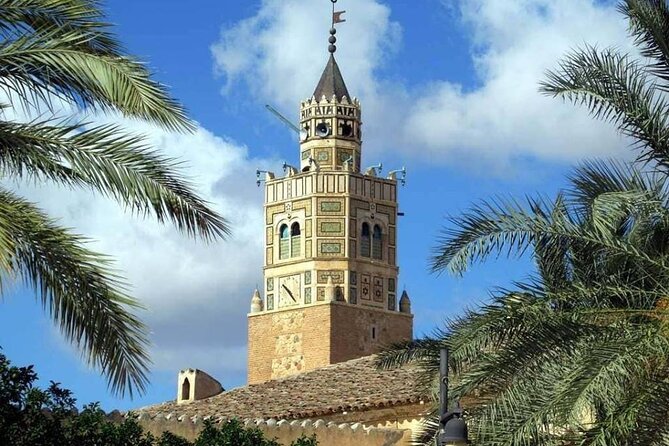
- Testour’s clock runs counterclockwise: The 23-meter octagonal minaret is the village’s most unusual landmark.
- Dougga gets the most time: You have about two hours to see the Capitol, theater, baths, forum, mausoleum, and other ruins.
- Bulla Regia adds something different: Its famous underground houses and religious buildings give the day a distinct second Roman site.
- This is a private tour: Only your own group takes part, with pickup offered and admission included.
- Guiding can make or break the day: Guides named in the experience feedback include Faouzi, Mohamed, and Chaoukni.
- Expect a very full day: The listed start is 7:30 am, and actual return time may be much later than the eight-hour estimate.
Why this private trip covers so much of Tunisia
This outing is aimed squarely at people who want ancient sites, not a resort-town sightseeing loop. From Hammamet, you head inland toward northwestern Tunisia, visiting three places that tell very different stories.
Testour reflects the arrival of Moorish and Andalusian communities in the early 17th century. Dougga shows how an indigenous settlement developed into a major Roman city. Bulla Regia reaches even farther back, with Numidian beginnings before its later Roman period.
I like the way the route combines a living village with two archaeological sites. You are not looking at ruins all day. Testour gives you streets, architecture, food, and a sense of modern local life before Dougga and Bulla Regia turn your attention to the ancient world.
The trip is private, so you do not have to match the pace of a large bus group. That matters at archaeological sites, where some people want a careful explanation of every monument while others prefer time to wander and take photographs. A private guide can also be more useful if someone in your group has trouble walking. One account specifically praised the guide for helping a companion with walking issues.
More Private Hot Spring Experiences in Hammamet:
- Istanbul: Private Turkish Bath, Massage, and Spa in Old City
★ 4.6 · 3,225 reviews - Istanbul: Private Turkish Bath, Sauna, and Massage
★ 4.8 · 1,306 reviews - Private Tour in Ephesus and Traditional Turkish Bath from Port
★ 5.0 · 675 reviews
Testour and its remarkable backward clock
Testour is the shortest stop, but it gives the morning a memorable opening. The village was founded by Moorish people at the beginning of the 17th century, and its Great Mosque reflects Andalusian design.
The minaret is the main attraction. It rises 23 meters, has eight sides, and is decorated with small double windows, glazed inscriptions, and architectural details linked to southern Spain. At the top, a mechanical clock turns counterclockwise. It is an odd, striking detail, and exactly the sort of thing that makes a brief stop worthwhile.
You take a panoramic look around the town rather than a long walking tour. That keeps the morning moving, though it also means you should not expect a full study of Testour’s buildings or daily life.
The food stop adds a local note. Cheese tasting is included as part of the visit, and pomegranate juice has also featured during the stop. Along the road to Dougga, one guide arranged a look at a Berber woman baking bread in an old furnace, followed by a taste of the bread. That sort of unscripted local moment can be one of the nicest parts of the day, though it may depend on timing and what can be arranged that morning.
Dougga, Tunisia’s major Roman highlight
Dougga is the heart of the trip. UNESCO added the site to its World Heritage List in 1997, describing it as the best-preserved small Roman city in North Africa. You get about two hours here, with admission included.
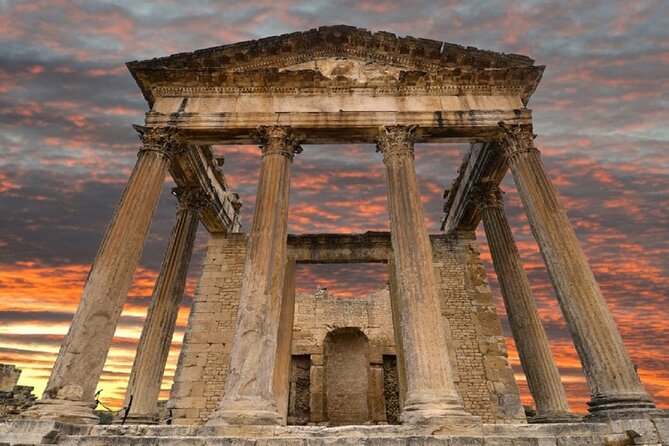
That sounds generous until you see the size of the ruins. Dougga preserves a remarkable collection of civic, religious, and entertainment buildings. The Capitol is the visual anchor, but you should not rush straight there and stop. The theater, forum, marketplace, baths, triumphal arch, and Libyco-Punic Mausoleum each help explain how the city worked.
The theater is one of the site’s most appealing structures. Its form is easy to understand, and its condition makes it easier to picture performances taking place there. The Venus Temple is another highlight mentioned during the experience, along with the Capitol and the place of the Rose of the Winds.
The Rose of the Winds is especially useful for understanding Roman public space. It was not simply decoration. The design connected directions and winds with the organization of the city, giving the open area a practical and symbolic role.
Look closely at the way different periods sit together. Dougga was not created as a Roman city from nothing. It began as an indigenous settlement, then changed under Roman rule. The mix of Libyco-Punic, local, and Roman elements is what makes the site more interesting than a simple collection of Roman columns.
Two hours lets you see the main monuments with a guide, but it is not enough for every corner at a relaxed pace. Wear comfortable shoes, keep water close, and listen for the guide’s suggested order. On a private tour, you can ask for more detail at the Capitol or take a little longer at the theater, but the day still has another major site ahead.
Bulla Regia and the cooler world below ground
Bulla Regia provides a useful contrast to Dougga. The site lies near Jendouba in northwestern Tunisia and traces more than 17 centuries of settlement.
The city began with the Numidians by the end of the sixth century BC at the latest. It later became a royal residence, was autonomous during the early Roman period, became a municipality under the Flavian emperors, and was made a Roman colony under Hadrian between AD 117 and 138.
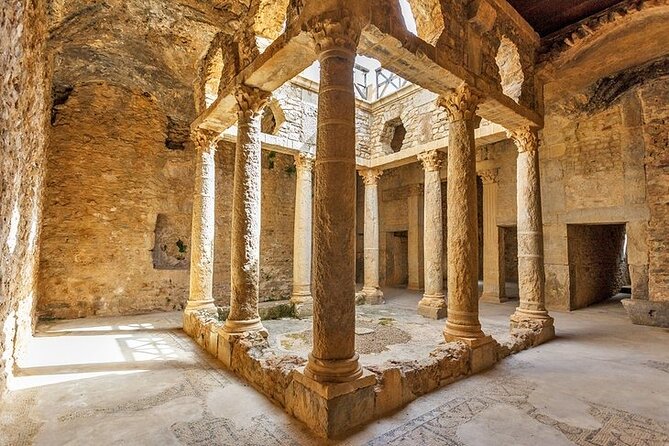
The feature that makes Bulla Regia special is its underground architecture. Wealthy homes were built partly below ground, creating cooler interior spaces during hot weather. The lower rooms and mosaics are central to the visit, and they give you something you do not get at Dougga: a clearer sense of domestic Roman life.
Bulla Regia is also known for religious buildings. The Capitol, Temple of Apollo, two Christian basilicas, and Church of Alexander are among the main remains. The site also reflects the changing religious life of the city, including the period when Augustine considered its inhabitants poor Christians in the late fifth century.
You have about two hours here. That is enough to make the visit worthwhile, but your energy may be lower by this point. Bulla Regia works best if you keep your attention on the underground homes and key religious buildings rather than trying to inspect every ruin in detail.
More Hot Spring Day Trips in Hammamet:
- Tunis, Sidi Bousaid and Carthage day trip from Hammamet
★ 4.5 · 44 reviews - Kairouan & El Djem Guided Day Trip with Lunch from Hammamet
★ 4.0 · 18 reviews - Budapest: Full-Day Gellért Spa Ticket
★ 4.2 · 3,340 reviews - From Valencia: Full Day Tour to Montanejos & Thermal Pools
★ 4.7 · 2,452 reviews
What the guide and driver add
The quality of this experience depends heavily on the people leading it. Guides named in the available feedback include Faouzi, Mohamed, and Chaoukni. Faouzi was praised for covering the main parts of the Roman sites carefully. Mohamed was described as friendly and able to connect ancient places with modern Tunisia. Chaoukni was noted for an early hotel pickup, safe driving, and explanations about local plants along the route.
You should confirm your pickup and guide details before departure, since the specific team may vary. A good guide is especially valuable at Dougga, where a column or broken wall can look like just another ruin until someone explains its purpose and period.
The private format also helps with practical problems. One guide adjusted the order of the visit when rain was approaching so the group could see the main features before the weather worsened. Another helped a person with limited walking ability. These are small details, but they matter on a long archaeological day.
There is one serious caution to keep in mind. A past outing was delayed after the driver hit another car. No one suffered serious injury, but it shows why you should allow flexibility rather than schedule an important evening plan immediately after the tour.
Price, timing, and the real value
The price is $133.57 per person. That is not the cheapest way to see these places, but the value improves if you are traveling with others because the service is private and group discounts are available.
Admission to Dougga and Bulla Regia is included, and pickup is offered. You are also paying for a dedicated vehicle, a driver, a guide, and the convenience of combining three distant stops in one day. Reaching these sites independently would require much more planning and reliable transport.
The advertised duration is about eight hours, beginning at 7:30 am. In practice, allow more room. One outing lasted 11.5 hours, likely because of road time, stops, weather, and the size of the sites. I would not book a fixed dinner, airport transfer, or evening performance soon after the planned return.
This is best treated as a full-day expedition from Hammamet, even if the headline duration sounds shorter. The early departure is useful because it gives you a better chance of seeing both major archaeological sites before the day becomes too tiring.
Who will enjoy this day most
I would choose this experience if you care more about ancient sites than about a relaxed schedule. It suits people who want Roman architecture, North African history, and a guide who can explain how local, Punic, Numidian, and Roman periods connect.
It is also a good match for couples, families, or friends who value a private vehicle and flexible attention. The trip can work for people with some walking limitations, since the guide may be able to offer help, but you should discuss your needs in advance. The sites are large, uneven archaeological areas, and the tour still involves substantial time on foot.
This is less suitable if you want a slow food-focused day, a short excursion, or a simple resort outing. Testour is brief, and the main focus is Dougga and Bulla Regia. You will spend a lot of time on the road, though the local stops and countryside views help break it up.
Practical advice for making the day easier
Start with a good breakfast before the 7:30 am pickup. Bring water, sun protection, and shoes suitable for uneven ruins. The sites are open-air and extensive, so comfort matters more than dressing up.
Ask your guide at the start how the time will be divided. Dougga deserves careful attention, while Bulla Regia has its own slower rhythm because of the underground rooms. If you want photographs, say so early rather than trying to squeeze them in at the end.
Keep an open mind about the exact flow of the day. The cheese tasting, pomegranate juice, bread baking, or local plant explanations may depend on timing and availability. They are valuable additions, but the core experience is the three historic sites.
Free cancellation is available up to 24 hours before the start time. Changes or cancellations inside that window are not accepted for a refund. Since the experience requires good weather, poor conditions may lead to a new date or a full refund.
Should you book this tour?
Book it if Dougga is high on your Tunisia wish list and you want to add Bulla Regia without arranging separate transport. The private setup, included admission, hotel pickup, and strong guiding make the $133.57 price easier to justify, especially for a small group.
Skip it if you dislike early starts, long drives, or full archaeological days. The eight-hour estimate can be optimistic, and the route may take closer to 11.5 hours. For the right person, though, this is one of the most rewarding ways to see Tunisia beyond Hammamet’s beaches: a backward clock in Testour, a superb Roman city at Dougga, and underground homes at Bulla Regia.
FAQ
What time does the tour start?
The stated start time is 7:30 am.
How long does the experience last?
The advertised duration is approximately eight hours, but one outing lasted 11.5 hours. You should allow extra time for the road, site visits, weather, and stops.
Is pickup available from Hammamet?
Yes. Pickup is offered, and the experience begins from Hammamet.
Is this a private tour?
Yes. Only your group participates in the activity.
Are admission tickets included?
Admission tickets are included for Dougga and Bulla Regia.
What places does the tour visit?
The route includes the Andalusian village of Testour, the ancient Roman city of Dougga, and the archaeological site of Bulla Regia.
Is food or drink included?
Testour includes a cheese tasting. Pomegranate juice and locally baked bread have also been part of the experience, though the supplied information does not state that every food or drink stop is guaranteed.
Can I cancel for a full refund?
You can cancel at least 24 hours before the experience start time for a full refund. Cancellations made less than 24 hours before departure are not refunded.
What happens if the weather is poor?
The experience requires good weather. If it is canceled because of poor conditions, you will be offered another date or a full refund.
New places to soak around Hammamet
- Tunis, Sidi Bousaid and Carthage day trip from Hammamet★ 4.5 · 44 reviews
- Kairouan, El Djem, Monastir Self-Guided Excursion from Hammamet★ 4.5 · 5 reviews
- Kairouan, El Djem and Monastir Guided Excursion from Hammamet★ 5.0 · 5 reviews
- Tour to the Medina of Hammamet and the Spice Market of Nabeul★ 4.0 · 45 reviews
- Private Guided Excursion Tunis, Carthage and Sidi Bou Said from Hammamet★ 5.0 · 8 reviews
- Paddle with us in Golf Hammamet★ 5.0 · 21 reviews
- From Hammamet: Sahara Desert Overnight Camping★ 4.5 · 2 reviews
- From Hammamet or Tunis: Carthage, Bardo, Sidi Bou said and Medina★ 4.5 · 30 reviews
Private Hot Spring Experiences: more water worth the trip.
Istanbul: Private Turkish Bath, Massage, and Spa in Old City
Read our review →
Istanbul: Private Turkish Bath, Sauna, and Massage
Read our review →
Private Tour in Ephesus and Traditional Turkish Bath from Port
Read our review →
Istanbul: Private Turkish Bath, Massage, and Pool in Taksim
Read our review →
Private Tour Mount Batur Sunrise Trekking and Natural Hot Spring
Read our review →
Private Turkish Bath Tradition, Massages, Swimming Pool & Sauna
Read our review →
Istanbul: Private Turkish Bath, Spa, and Massage in Sisli
Read our review →
Istanbul: Hammam and Spa Private Turkish Bath Experience
Read our review →Lists this soak appears on