
Review · TUNISIA
From Hammamet or Tunis: Carthage, Bardo, Sidi Bou said and Medina
Carthage, Sidi Bou Said, the Bardo Museum, and Tunis Medina give you four very different views of Tunisia in one long day. You move from ruined Punic and Roman streets to sea views, Roman mosaics, old markets, and the Zitouna Mosque. It is a smart first look at Tunisian culture, especially if you do not have time to arrange each stop yourself.
I like the private format, since your guide can pay attention to your pace and interests. I also like the range of the day: Carthage gives you open-air archaeology, while the medina brings you into the sounds, smells, and tight lanes of present-day Tunis.
The main drawback is time. Eight hours sounds generous, but Carthage alone includes several stops, and the Bardo Museum can easily claim an hour or more. If you prefer slow museum visits or long café breaks in Sidi Bou Said, this schedule may feel brisk.
Key points to know before booking
- Four major sights in one day: Carthage, Sidi Bou Said, the Bardo Museum, and Tunis Medina cover ancient, artistic, coastal, and urban Tunisia.
- Private transport and guiding: Only your group takes part, with pickup offered from Hammamet or Tunis.
- Carthage gets the largest share of time: The archaeological area, Antonine Baths, Tophet, and aqueduct together take about four hours.
- The Bardo Museum is a highlight for art lovers: Its Roman mosaic collection gives useful context to the ruins you see earlier.
- Guides can make the difference: Bouhdid, Haythem, Boutheina, Haudi, Saïf, and others have been praised for clear English, warmth, patience, and flexibility.
- Plan around the Monday closure: The Bardo Museum is closed on Mondays, so check your date before paying.
Why this makes a strong first day in Tunis
This tour works because it does not show you only one side of Tunisia. Carthage explains the ancient world, Sidi Bou Said shows the country’s coastal charm, the Bardo Museum gathers its art under one roof, and the Medina puts you inside the daily life of Tunis.
I especially like the order of ideas, even if the exact driving sequence can vary. After seeing ruins in the open air, you get a museum visit that helps explain what you have seen. Later, the Medina shifts the focus from archaeology to living streets, shops, religious buildings, and local crafts.
At $35 per person, the price is low for a full private day with pickup, a driver, a guide, and several included admissions. The value depends partly on your pickup point and group size, but the private arrangement makes the cost more attractive if you are traveling with family or friends. You are not simply buying a ticket to one monument. You are paying for transport between several spread-out sights and for help making sense of them.
The tour has a 4.6 rating from 30 reviews, with 93 percent recommending it. More useful than the numbers is the pattern in the feedback: the guides are repeatedly praised for clear explanations, friendly personalities, safe driving, and attention to individual needs.
More warm water worth the trip in Hammamet:
- Quad ride on the hills of Hammamet
★ 4.0 · 104 reviews - 2-Day Tunisian Sahara Tour with Food & Stay from Hammamet
★ 4.5 · 80 reviews - Tour to the Medina of Hammamet and the Spice Market of Nabeul
★ 4.0 · 45 reviews
Carthage: begin with a city scattered across the coast
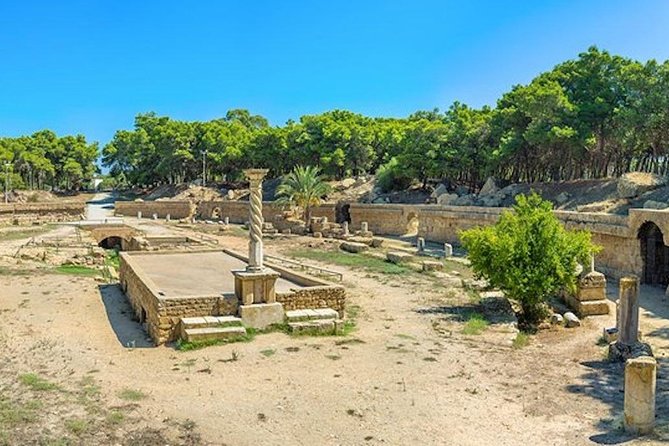
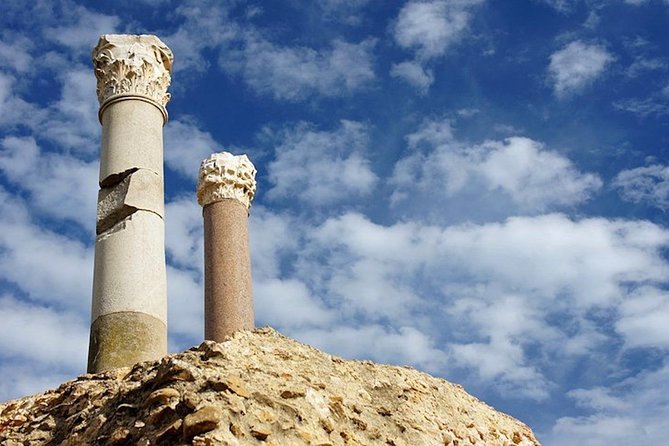
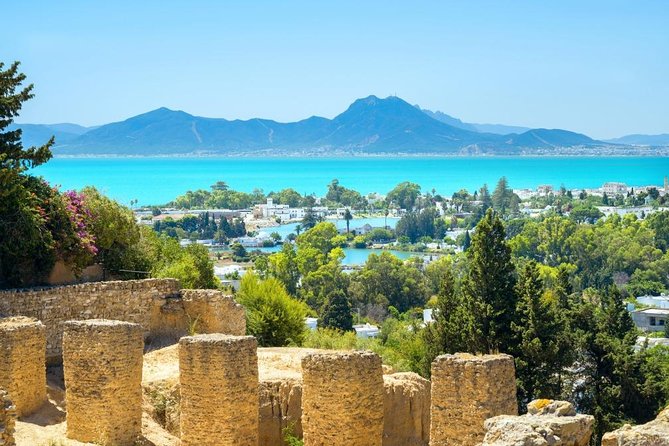
Carthage is not one compact ruin with a single dramatic entrance. It is a broad archaeological area, and that matters when you plan your expectations. You see remains spread around Byrsa Hill and the coast, with open views and fragments of a city that was once much larger than what survives today.
The ancient city was destroyed by the Romans in 146 BC, but excavation has revealed an impressive level of urban planning. The remains include five-story homes, sewage systems, and city walls that once stretched about 21 miles, or 34 kilometers, across Byrsa Hill.
Your main Carthage visit lasts about two hours, followed by separate stops at the Antonine Baths, Tophet, and the aqueduct. Admission is included for the archaeological sites, which saves you from handling several separate entries.
Bring your imagination. Carthage is rewarding because of its scale and setting, not because every building remains intact. Your guide is important here. A good explanation can help you picture streets, homes, defenses, and public spaces where you may otherwise see only foundations and stone blocks.
The Antonine Baths and the Roman shore
The Baths of Antoninus receive about 30 minutes, which is enough for a focused visit but not a slow archaeological study. The site gives you a sense of the scale of Roman public construction, with broad remains set close to the sea.
I would treat this stop as one of the visual highlights of Carthage. The combination of ancient masonry and coastal views makes it easier to connect the history to the place itself. You can look across the ruins and understand why this part of Carthage remains so memorable, even when only partial structures survive.
The short visit also helps keep the full day moving. If you become absorbed in ancient architecture, you may wish you had more time here. Still, the schedule gives you several other parts of Carthage rather than spending the whole morning at one location.
Tophet: a more serious archaeological stop
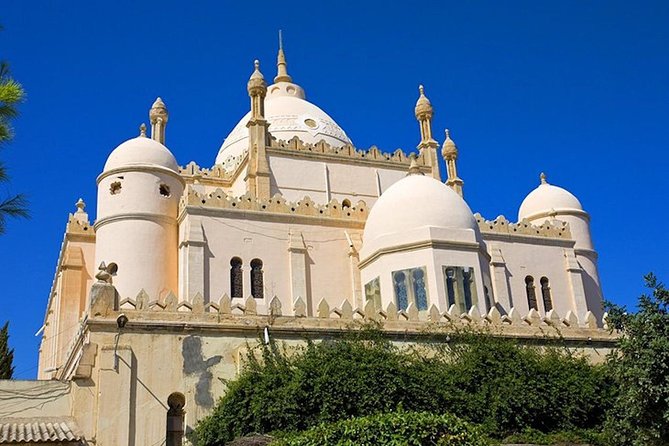
The Tophet receives about an hour, giving your guide time to explain why this religious and archaeological area matters. It is not simply another scenic ruin. You may find the subject matter more serious than the open views at the Baths or the relaxed streets of Sidi Bou Said.
Listen closely to the guide here, since the importance of the site is easier to understand through context than through the remains alone. The private setting is useful because you can ask questions without worrying about holding up a large group.
This stop may not suit children or adults who want only light sightseeing, though the tour data says most people can participate. The experience covers a lot of ground, so having a guide who can adjust the explanation to your interests is a real advantage.
Same steam, a different pool:
- Tunis, Sidi Bousaid and Carthage day trip from Hammamet
★ 4.5 · 44 reviews - Half a day in Sidi Bousaid from Hammamet
★ 4.0 · 33 reviews - Paddle with us in Golf Hammamet
★ 5.0 · 21 reviews - Private Day Trip to Testour, Dougga and Bulla Regia from Hammamet
★ 5.0 · 21 reviews
The Carthage aqueduct and the value of smaller stops
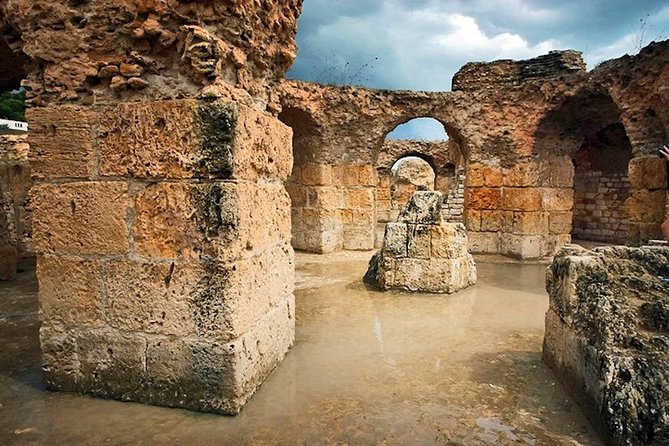
The aqueduct stop lasts about 30 minutes. It is shorter than the main archaeological visit, but it adds another piece to the picture of how Carthage functioned as a major city.
I like these smaller stops because they prevent the day from becoming a simple parade of famous names. You see not just temples and baths, but also the practical systems that supported urban life. The short time means you should expect an introduction rather than a full engineering lesson.
Together, the four Carthage sections take about four hours. That is a substantial share of the day and one reason you should wear comfortable shoes and be ready for outdoor walking. The information provided does not specify the amount of shade or the walking surface at every stop, so sensible sun protection is worth bringing.
Sidi Bou Said: blue-and-white streets above the Mediterranean
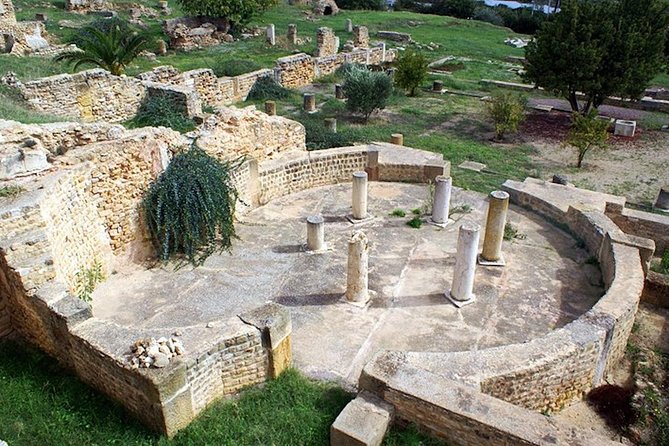
After the archaeological sites, Sidi Bou Said changes the mood completely. This coastal village is known for its blue-and-white streets, Mediterranean views, and relaxed atmosphere. You get about an hour here, with no admission charge.
The appeal is visual and immediate. White walls, blue details, narrow streets, and views toward the water give you a welcome pause after Carthage’s stones and open archaeological ground. I would use this hour to walk rather than rush from one landmark to another.
The schedule is not long enough for a slow afternoon. You may have time to browse, take photographs, and enjoy the setting, but not to explore every lane or settle in for an extended meal. If Sidi Bou Said is the part of Tunisia you most want to savor, tell your guide early. The private format may allow some flexibility, though the overall day still has several fixed stops.
One person traveling with a baby praised guide Haythem for making the outing smooth and paying attention to the child’s needs. That does not guarantee the same guide or identical arrangements, but it suggests that the private setup can be useful for families who need a little patience and flexibility.
The Bardo Museum and its Roman mosaics
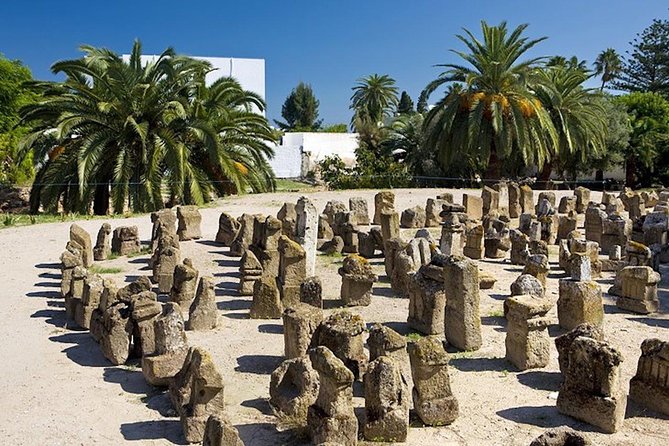
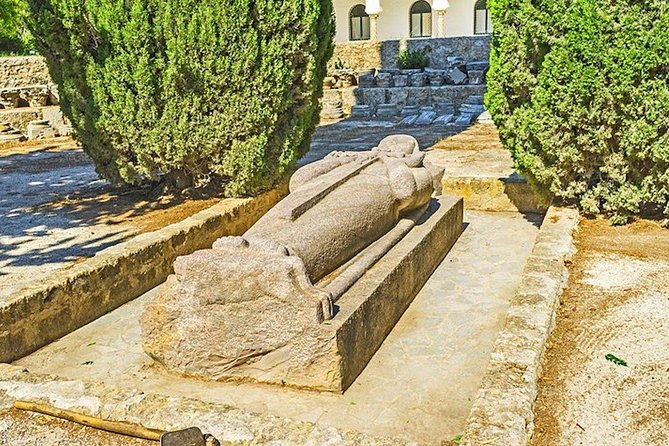
The National Museum of Bardo receives about an hour and admission is included. Its main draw is one of the world’s largest collections of Roman mosaics, along with artifacts that help explain Tunisia’s long past.
I see the Bardo as the tour’s best indoor counterpoint to Carthage. At the ruins, you work from foundations and fragments. At the museum, mosaics and objects give you a clearer look at the art and daily world connected to ancient Tunisia.
One hour is enough for a strong introduction, but it is not enough for every gallery in detail. This is the most likely part of the day to feel rushed if you enjoy museums. One family specifically wished for less museum time and more time in Carthage and Sidi Bou Said, while other feedback praised the museum explanations. That difference comes down to taste.
If art and archaeology are your priority, tell the guide. If you would rather keep moving, you can ask for a focused visit. The museum is closed on Monday, so do not book this exact plan for that day without confirming an alternative.
Entering Tunis through Bab Bhar
Bab Bhar, or the Gate of the Sea, is a brief 15-minute stop. It introduces you to the historic center and marks the transition into the Medina of Tunis.
A short stop here may seem minor compared with Carthage or Bardo, but it helps you understand the shape of the old city. The gate is a clear meeting point between the newer city and the old quarter, and it prepares you for the tighter streets ahead.
You do not need a long visit to appreciate it. Think of Bab Bhar as an orientation stop, not a major standalone attraction.
Zitouna Mosque and the Medina’s working streets
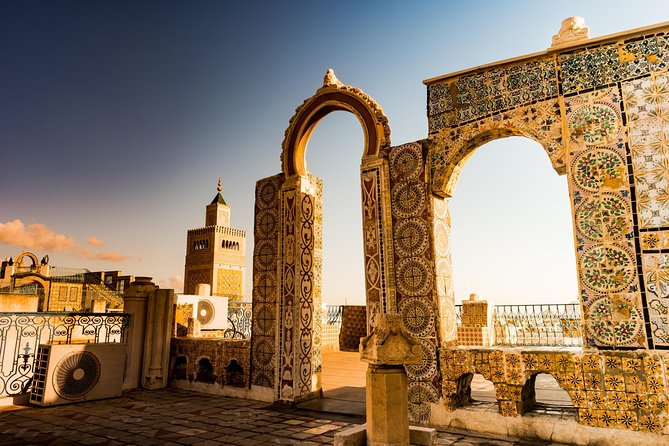
The Medina of Tunis receives about an hour. You follow the guide through narrow streets toward the Zitouna Mosque, a traditional cap-makers market, and a colorful perfume market. Admission is listed as free.
This is where the tour feels most connected to everyday Tunis. The Medina is not an open-air museum frozen in time. It is a working part of the city, with shops, trade, religious buildings, and the constant movement of people through old lanes.
The route can feel crowded and visually busy, so stay close to your guide. A guide also helps you notice details you might pass without understanding, such as the purpose of a market or the role of a traditional craft.
The Zitouna Mosque is included in the route, but the information provided does not specify interior access or any clothing rules. Follow your guide’s instructions and do not assume that every part of the mosque is open during your visit.
An hour gives you a useful taste of the Medina, though not a full exploration. If shopping is important to you, ask how much time is available before stopping at a stall. Otherwise, the markets can easily absorb the remaining minutes.
Guides, drivers, and the private format
The strongest part of this experience is likely to be the person assigned to your group. Guides named in the feedback include Bouhdid, Haythem, Boutheina, Haudi, Saïf, and Bhudit. They were praised for friendly conversation, strong English, useful historical explanations, and the ability to adjust the pace.
One guide, Bouhdid, was described as especially good at fitting a lot into one day while keeping the information interesting. Boutheina was praised for an energetic personality during the museum visits. Haudi made the day feel informal and companionable, while Saïf received praise in French for presenting Tunisian culture well.
Drivers also matter on a long outing. Halim and Momo were singled out for careful, comfortable driving, and one German-speaking guide combination included an air-conditioned vehicle and a calm driver. The exact guide, driver, and vehicle are not guaranteed, but the private arrangement means you avoid the feel of a large coach group.
The tour is listed as suitable for most people and pickup is offered. Vegetarian food can be arranged if you mention it when booking. The supplied details do not give a set lunch plan, so ask about meal timing if that matters to you.
Who will get the most from this day
I would recommend this tour to you if you are visiting Tunisia for the first time, have one free day for Tunis, or want an organized introduction without arranging several taxis and admissions. It also suits families and small groups that value private transport and a guide who can respond to questions.
It may be less suitable if you want a slow, specialist visit to Carthage or the Bardo Museum. The schedule covers a great deal, and the Medina and Sidi Bou Said each deserve more than the allotted hour if you want unhurried shopping, photography, or café time.
The tour requires good weather. You can cancel up to 24 hours before the start for a full refund, while bad weather or failure to reach the minimum number of participants may lead to a new date or a refund.
Should you book this Carthage and Tunis tour?
Book it if your priority is breadth. For $35 per person, you get a private eight-hour introduction to the area’s major ancient, artistic, coastal, and urban sights, with admissions included at Carthage and the Bardo Museum.
Before booking, check three things: your date is not a Monday, your group is comfortable with a full day of sightseeing, and you are happy with an overview rather than a leisurely study of each place. If that sounds right, this is a practical way to get your bearings in Tunis and see the contrasts that make the region so rewarding.
FAQ
How long does the tour last?
The tour lasts approximately eight hours.
Where does the tour depart from?
Pickup is offered from Hammamet or Tunis.
Is this a private tour?
Yes. Only your group participates in the private activity.
How much does the tour cost?
The listed price is $35 per person.
Is admission to Carthage included?
Yes. Admission is included for the archaeological site, the Antonine Baths, the Tophet, and the Carthage aqueduct.
Is admission to the Bardo Museum included?
Yes. Admission to the National Museum of Bardo is included.
Is the Bardo Museum open every day?
No. The Bardo Museum is closed on Mondays.
How much time is spent at Sidi Bou Said?
The planned visit to Sidi Bou Said lasts about one hour, and admission is free.
Does the tour visit the Medina of Tunis?
Yes. The Medina visit lasts about one hour and includes the area around the Zitouna Mosque, a cap-makers market, and a perfume market.
Can I request vegetarian food?
Yes. A vegetarian option is available, but you should request it when booking.
New places to soak around Hammamet
- Kairouan, El Djem, Monastir Self-Guided Excursion from Hammamet★ 4.5 · 5 reviews
- Tunis, Sidi Bousaid and Carthage day trip from Hammamet★ 4.5 · 44 reviews
- Kairouan, El Djem and Monastir Guided Excursion from Hammamet★ 5.0 · 5 reviews
- Tour to the Medina of Hammamet and the Spice Market of Nabeul★ 4.0 · 45 reviews
- Private Guided Excursion Tunis, Carthage and Sidi Bou Said from Hammamet★ 5.0 · 8 reviews
- Paddle with us in Golf Hammamet★ 5.0 · 21 reviews
- Private Day Trip to Testour, Dougga and Bulla Regia from Hammamet★ 5.0 · 21 reviews
- From Hammamet: Sahara Desert Overnight Camping★ 4.5 · 2 reviews