
Review · TUNISIA
Kairouan, El Djem, Monastir Self-Guided Excursion from Hammamet
Kairouan’s old medina, El Djem’s enormous Roman amphitheater, and Monastir’s seaside monuments give you three very different views of Tunisia in one long day. The route moves from the country’s Arab-Muslim center to Roman Africa and then to modern Tunisia, making the historical range the main reason to book.
I like the private vehicle for up to three people, since your group avoids a large coach and can spend time where it matters most. I also like the air conditioning, bottled water, included insurance, and private transport, practical comforts on a 10-hour road day.
The main tradeoff is that this is self-guided rather than a fully escorted tour. Entrance fees, lunch, tips, and personal costs are extra, and one past booking raised concerns about an unexpectedly priced local guide and rushed time in Monastir, so confirm any added service and keep safety ahead of the schedule.
Key points to know before booking
- Three eras in one day: Kairouan represents Arab-Muslim Tunisia, El Djem showcases Roman Africa, and Monastir connects Punic and Roman origins with the modern republic.
- Private travel for up to three: The $303.51 group price is easier to justify when divided among two or three people.
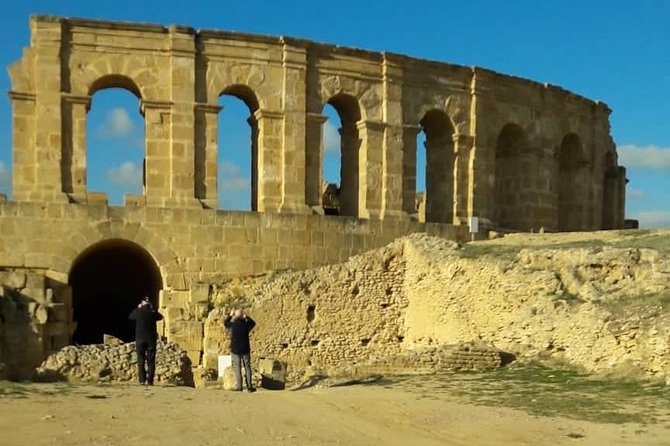
- El Djem is the day’s major attraction: The amphitheater could hold about 30,000 spectators and is one of Africa’s most striking Roman monuments.
- Self-guided sightseeing: A professional guide is not included, and museum and monument admission charges are extra.
- A full 10-hour schedule: The planned stops total several hours before allowing for road time, so expect a busy day rather than a slow-paced outing.
- Pickup begins at 8:30 a.m.: Pickup is offered, with a mobile ticket and confirmation provided at booking.
Why this route works so well from Hammamet
This excursion makes sense if you want more than a beach day but do not want to arrange several separate trips. From Hammamet, you travel inland to Kairouan, continue to El Djem, and finish in Monastir. The sequence gives the day a clear shape, even though the schedule is demanding.
I like the way the route covers three different chapters of Tunisian history. Kairouan is tied to Islam and traditional medina life. El Djem shows the wealth and scale of Roman North Africa. Monastir brings in the country’s modern political story through Habib Bourguiba, Tunisia’s first president, while still offering a ribat and marina.
At $303.51 per group of up to three, the value depends heavily on your party size. One person pays a high private-tour rate, but two or three people can split the cost. Private transportation, an air-conditioned vehicle, bottled water, insurance, and taxes are included. You still need to budget for lunch and entry tickets.
This is not the best choice if you want a guide explaining every site as you walk. It suits you better if you enjoy looking around independently, reading signs, hiring a local guide only when you choose, or simply seeing the main sights with transport handled for you.
Self-guided soaks around Hammamet:
- Tunis, Carthage and Sidi Bou Said Self-Guided Excursion from Hammamet
★ 4.5 · 4 reviews - Cap-Bon Self-Guided Excursion from Hammamet
★ 4.5 · 3 reviews - Zaghouan, Thuburbo Majus and Dougga Private Self-Guided Excursion from Hammamet
★ 5.0 · 2 reviews
Kairouan’s Aghlabid Basins and water engineering
The first stop is the Bassins Aghlabites, located outside Kairouan’s medina walls. You have about 30 minutes here, and the admission fee is not included.
These ninth-century basins are more than a quick photo stop. They were part of a major water system built during the second half of the ninth century and are considered among the most important hydraulic works in the history of the Muslim world. Their value comes from what they explain about Kairouan itself: this inland city needed serious planning to secure and manage water.
Thirty minutes is enough for a look and some photographs, but not enough for a long, detailed study. Since you do not have a professional guide included, you may want to read a little about the Aghlabid period before leaving Hammamet. That preparation will help you understand why a large water installation matters here.
Sidi Sahbi Mosque and Kairouan’s devotional side
Next comes the Mosque of Sidi Sahbi, also known as the Mosque of the Barber. It is outside the walls of the medina and is linked to the mausoleum of Sidi Sahbi. The planned visit lasts about one hour, and admission is listed as free.
This stop shifts the day from engineering to religious architecture and devotion. Kairouan is regarded as the fourth holy city of Islam and Tunisia’s spiritual capital, so Sidi Sahbi gives you a direct sense of the city’s religious importance.
Take your time with the courtyards, tilework, and decorative details you can see during the visit. The name Mosque of the Barber refers to the tradition that Sidi Sahbi carried hairs from the Prophet Muhammad’s beard. You should treat the site as a religious place, not just another monument, and follow any local rules about dress or access.
Because this trip is self-guided, the driver may get you to the site but is not serving as a formal cultural interpreter. That keeps the price simpler, but it also means you are responsible for making the most of the stop.
Kairouan’s medina, three gates, and narrow streets
The medina receives about an hour. It has been on the UNESCO World Heritage List since December 9, 1988, and its narrow streets and markets give you a different experience from the open space around the basins.
The visit includes the Mosque of the Three Gates and time to explore the old city. I like this part because it lets you move from major monuments into the everyday texture of Kairouan. The streets, markets, walls, and smaller architectural details help you see the city as a living urban center rather than a string of isolated sights.
One hour goes quickly. If shopping interests you, you may need to choose between browsing and taking in the architecture. Keep an eye on the meeting time, since the route still has El Djem and Monastir ahead.
Kairouan is also known for traditional crafts, including carpets, though this excursion does not promise a carpet demonstration or shopping session. Do not assume a purchase stop is part of the day. The point here is a short, focused look at the medina.
Guided soaking days around Hammamet:
- Kairouan & El Djem Guided Day Trip with Lunch from Hammamet
★ 4.0 · 18 reviews - Private Guided Excursion Tunis, Carthage and Sidi Bou Said from Hammamet
★ 5.0 · 8 reviews - Kairouan, El Djem and Monastir Guided Excursion from Hammamet
★ 5.0 · 5 reviews - Guided Excursion Cap-Bon from Hammamet
★ 5.0 · 2 reviews
El Djem’s 30,000-seat Roman amphitheater
El Djem is the strongest reason many people will choose this excursion. The visit to the amphitheater is scheduled for two hours, and the entrance fee is extra.
The monument was built in the third century AD in the ancient city of Thysdrus, one of the most prosperous cities of Roman Africa. It could hold about 30,000 spectators, making it the third-largest Roman amphitheater after those in Rome and Capua. Even without a guide, the size is easy to grasp once you walk inside.
You can expect broad seating levels, huge stone passages, and views down into the arena. The lower areas help you imagine the practical workings of the building, while the upper sections show how much land and labor went into creating a venue for mass entertainment.
The two-hour allotment is generous compared with the shorter Kairouan stops. Use it to explore at your own speed instead of rushing from the entrance to the exit. This is also the place where a few minutes of reading beforehand pays off. Knowing that the building belongs to the prosperous Roman period of Thysdrus gives the stones more meaning.
The amphitheater was classified as a UNESCO World Heritage site in 1972. That designation does not replace the experience of being there, but it confirms the site’s importance. El Djem is not a minor provincial ruin. It is a major Roman monument in Africa, and it deserves the longest single visit on the route.
The El Djem Archaeological Museum and its Roman villa
The archaeological museum follows the amphitheater, with about one hour planned and admission not included. It is housed in a reconstructed Roman villa, which makes the stop useful as a companion to the arena.
Inside, you can see Roman mosaics, statues, terracotta figures, perfume containers, and other glass objects. The collection covers a period described as running from the fifth to the eleventh century, so it adds smaller, more detailed objects to the massive stone architecture you have just seen.
I like this pairing. The amphitheater shows public life and spectacle on a grand scale. The museum offers a closer look at homes, decoration, craft, and personal objects. If you only visit the amphitheater, you miss much of the evidence for how people in this wealthy Roman city lived.
The museum also provides a change of pace. After walking through a large outdoor monument, you can spend time studying mosaics and objects in a more contained setting. If heat is a concern, this indoor stop may be welcome, though the admission charge remains separate.
Monastir’s Bourguiba Mausoleum, ribat, and marina
Monastir is the final stop, with about one hour for the town and waterfront. The plan includes passing the birthplace of Habib Bourguiba, visiting his mausoleum, and allowing free time for the ribat and marina. Entrance fees are not included.
This part of the day brings Tunisia into the modern era. Bourguiba was the first president of the Tunisian Republic, and the mausoleum connects the city to the country’s twentieth-century political story. The stop is quite different from Kairouan and El Djem, which is exactly why it belongs on this route.
The ribat gives you another historical layer. Monastir began as a Punic and later Roman city called Ruspina, and the town also has a strong Islamic defensive tradition. With only an hour, you probably cannot explore every part at a leisurely pace. Decide before arrival if the mausoleum, ribat, or marina matters most to you.
The schedule deserves careful attention here. One past booking reported reaching the mausoleum but not having enough time for the ribat. That does not mean the same thing will happen to you, but it is a useful warning: ask early how much time remains and state clearly which Monastir sights you want to visit.
What the private transport adds
The vehicle is air-conditioned, private, and limited to your group, with a maximum of three people. Bottled water, insurance, taxes, and private transportation are included. Pickup is offered, and the scheduled start is 8:30 a.m.
For a long route, these details matter. You do not have to share the day with a large group, and you can discuss the order of stops or the amount of time spent at each location. The private format is especially useful for couples or a small family that wants a direct day out.
You should also keep expectations clear. The driver is not a professional guide, and the tour does not include lunch. The driver may help with the practical side of the route, but you should not expect a full lecture at every monument.
One past account raised concerns about an offer of a local guide in Kairouan at one price, followed by a request for a much higher amount. If someone offers you an extra guide, agree on the total cost before the service begins. Ask what the price covers and do not feel pressured to accept.
Safety matters just as much as speed. A past account also expressed concern about very fast driving. I cannot verify that report, but you should feel free to ask the driver to keep to safe speeds and to say something if the driving feels uncomfortable. A historic site is not worth arriving at in a hurry.
Timing, meals, tickets, and practical costs
The experience lasts about 10 hours, beginning at 8:30 a.m. The listed sightseeing time adds up to several hours, and the remaining time is needed for transport between Hammamet, Kairouan, El Djem, and Monastir.
Lunch is not included. You should plan for that expense, along with admission to the Aghlabid Basins, El Djem amphitheater, El Djem Archaeological Museum, and Monastir attractions where charges apply. The Mosque of the Barber and Kairouan medina are listed with free admission.
The mobile ticket is convenient, and confirmation is provided at booking. Free cancellation is available if you cancel at least 24 hours before the start time. Cancellations or changes made within 24 hours are not refunded or accepted.
Most people can participate, and service animals are allowed. The activity is private, meaning only your own group takes part.
Who should book this day trip
I would choose this excursion if you want to see several major sites without renting a car or organizing separate transport. It is particularly suited to two or three people who can share the group price and who prefer private travel over a large coach.
History-minded visitors will get the most from it. Kairouan offers religious and urban heritage, El Djem supplies the dramatic Roman monument, and Monastir adds both modern political history and coastal sights.
I would think twice if you want a slow day, a guaranteed expert guide, or plenty of time for each Monastir attraction. The route covers a lot of ground, and the final stop can feel compressed if earlier visits run long.
Should you book the Kairouan, El Djem, and Monastir tour?
Book it if your priority is maximum historical variety in one day. El Djem is the clear centerpiece, while Kairouan makes the route more meaningful and Monastir rounds it out with a different setting and period.
The best value comes when three people share the $303.51 price. Before departure, confirm the pickup details, ask about the planned time in Monastir, and agree in advance on the price of any optional local guide. If you want a private vehicle and can manage a long day without a formal guide, this is a practical way to reach three important Tunisian sites from Hammamet.
FAQ
What is included in the tour price?
The price includes bottled water, an air-conditioned vehicle, private transportation, all fees and taxes, and insurance.
How many people can join the private tour?
The private group can include up to three people.
What time does the excursion start?
The scheduled start time is 8:30 a.m.
Is lunch included?
No. Lunch is not included, so you need to pay for it separately.
Are entrance tickets included?
No. Admission fees for museums and exhibitions are not included. Specific stops also list admission as extra, including the Aghlabid Basins, El Djem amphitheater, El Djem Archaeological Museum, and Monastir attractions.
Is a professional guide included?
No. A professional guide is not included. The experience is primarily self-guided, although an optional local guide may be offered separately.
Can I cancel for a full refund?
Yes. You can receive a full refund if you cancel at least 24 hours before the experience start time. Cancellations or changes made less than 24 hours before the start are not refunded or accepted.
New places to soak around Hammamet
- Tunis, Sidi Bousaid and Carthage day trip from Hammamet★ 4.5 · 44 reviews
- Kairouan, El Djem and Monastir Guided Excursion from Hammamet★ 5.0 · 5 reviews
- Tour to the Medina of Hammamet and the Spice Market of Nabeul★ 4.0 · 45 reviews
- Private Guided Excursion Tunis, Carthage and Sidi Bou Said from Hammamet★ 5.0 · 8 reviews
- From Hammamet: Sahara Desert Overnight Camping★ 4.5 · 2 reviews
- Paddle with us in Golf Hammamet★ 5.0 · 21 reviews
- Private Day Trip to Testour, Dougga and Bulla Regia from Hammamet★ 5.0 · 21 reviews
- From Hammamet or Tunis: Carthage, Bardo, Sidi Bou said and Medina★ 4.5 · 30 reviews